
Psych Meds No Better than Street Drugs? Turns out They Have a Lot in Common
Street drugs and psychiatric medication actually have a lot of things in common. Are you surprised? Well, allow me to elucidate.
Apparently, they work the same way.
[The] ex-director of the NIMH, Steve Hyman, upon summarizing over 40 years of research pertaining to the effects of antipsychotic drugs, reported that the use of the drugs actually creates, rather than corrects, a biochemical imbalance within the brain and in fact works similar to drugs of choice or street drugs.
– Ty C. Colbert, Psychologist (2017). The Four False Pillars of Biopsychiatry.
As you can see, a former director of the National Institute of Mental Health admitted that psych meds are really no different than recreational drugs in the way that they affect the brain. Like street drugs, they boost mood by artificially increasing specific chemicals in the brain.
Both make you dependent on a crutch.
Whether you get a drug from a psychiatrist sitting in a beautiful office with a row of framed degrees on the wall, or a scruffy drug dealer on the corner of the street, the result is ultimately the same: you’ll be dependent on a chemical in order to feel better. Drugs can be just a crutch that make you feel better without doing away with the situations, memories, inactions, or whatever else is at the core of the problem. Just as with a crutch, you become dependent on an external source (pills, injections, etc) to keep you functioning.
Both cause withdrawal symptoms.
Television and movies have familiarized most of us with how a drug addict in withdrawal looks like – an anxious, vomiting, agitated mess. But did you know that psychiatric drug withdrawal can be just as unpleasant?
You can find some horrible accounts of psych med withdrawal. Here are three from the anti-psychiatry, mental health, and dysautonomia sections of Reddit.
Cymbalta and Seroquel withdrawal:
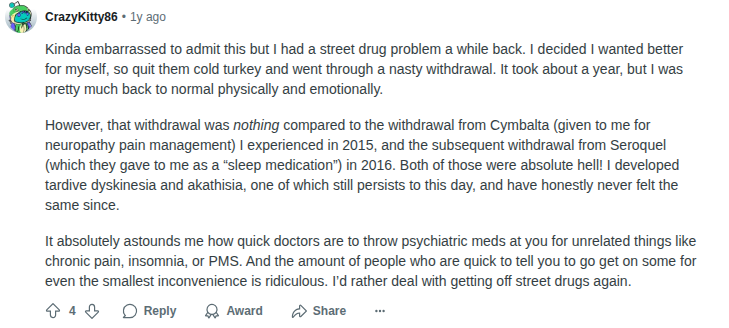
By the way, tardive dyskinesia and akathisia are both movement disorders that are potential side effects of antipsychotics. Tardive dyskinesia involves involuntary and uncontrollable movements of the body and face (sticking out the tongue, rocking, grimacing, and so forth). People with akathisia experience unpleasant inner restlessness or tension that impels them to fidget or otherwise move around for relief.
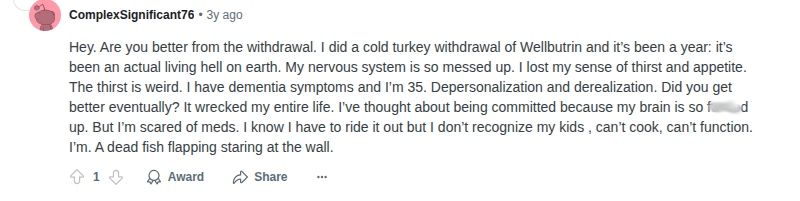
Wellbutrin withdrawal:
Effexor withdrawal:

Either one can make you complacent in a bad place. You are not forced to face the actual issues.
Zoloft, Risperdal, LSD, marijuana, and so forth do not “cure” psychological problems. If the reason you are depressed is because you hate your job and can’t bear to face another day, Zoloft may make it easier for you to wake up, go to work, and make it through your shifts. However, if you just found a new and better job, the much touted “chemical imbalance” behind your depression would suddenly resolve, with no more need for pharmaceutical intervention.
Believe it or not, psych meds can actually be used to enable addiction to street drugs. A heroin addict, for example, may get terrible sleep quality as a result of his addiction. Under normal conditions, he may be forced to quit or cut back simply because the side effects of the heroin are too disabling. However, if he is able to get a prescription for Seroquel (which commonly happens), this medication that is normally prescribed for schizophrenia and bipolar disorder will allow him to get some sleep. The heroin addict will then feel more comfortable continuing his addiction. Ultimately, he is enabled by psychiatric medication.
Both psych meds and street drugs can make you feel better, but unfortunately this can take away away the drive or motivation to fix the real problem. In general, when people feel comfortable, there is a decreased impetus to fix a problem, simply because it doesn’t feel as big anymore. Therefore, these “feel-good” chemicals can enable people to avoid dealing with their problems.
For example, a woman in an abusive relationship may take Xanax and find that she feels better. She may get in the habit of taking it whenever her partner demeans her. It becomes her “happy pill,” and she is able to bear the abuse simply due to this outlet. On the flip side, if she wasn’t able to get this pleasant escape every day, the unhappy feelings from her relationship may be too much too bear on their own, and she will feel impelled to quit the relationship sooner than she would have otherwise, simply because the only escape she sees now is to get away from the actual source of bad feelings.
Both have potentially horrible side effects
Most of us are familiar with the side effects of street drug use – meth mouth, psychosis, fits of paranoia, and so forth. How many are truly informed of the risks of taking psychiatric medications, other than a brief warning about, say, Stevens-Johnson syndrome or sexual dysfunction?
Speaking of sexual dysfunction, this is actually a very common side effect for antidepressants – very common as in you are more likely to experience it than not. On average, over half of people on SSRIs experience sexual dysfunction, with the incidence climbing as high as 65% for those taking paroxetine (Paxil). For those already struggling with depression, being unable to be intimate with a spouse doesn’t sound very helpful.
As for antipsychotics, weight gain is possibly one of the most common side effects. In fact, I remember a psych provider I worked with saying that, with Zyprexa in particular, you are pretty much guaranteed to put on twenty pounds immediately upon starting this drug due to its metabolic effects. Having psychosis can feel overwhelming on its own. Adding weight issues on top of that, especially in a nation where weight gain is an ongoing societal problem, seems like adding insult to injury.
But it gets even worse.
Here is a horror story, again from Reddit:
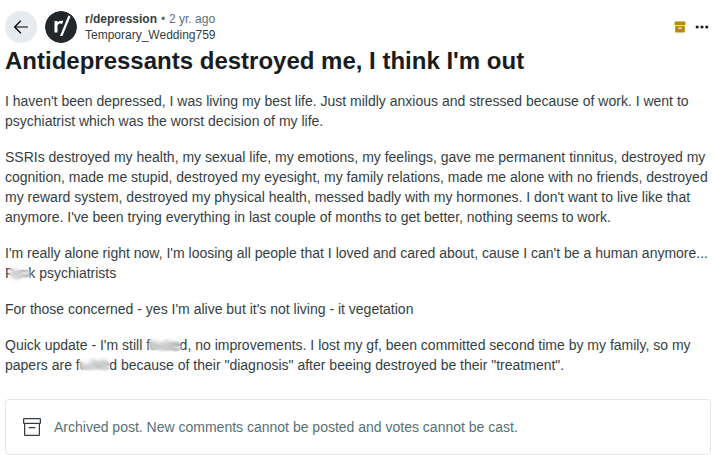
Psych meds can can blunt out people’s emotions to the point that they become living zombies, sucking the personality, meaning, and emotion out of their lives and damaging their relationships.
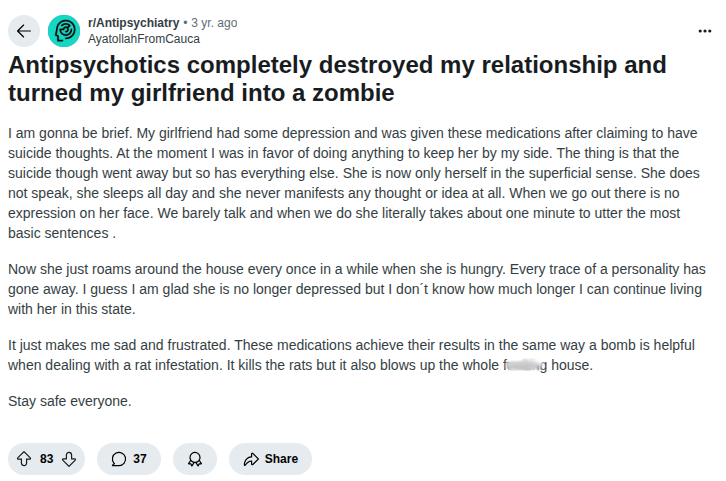
That was not an isolated case, as here is a similar account:
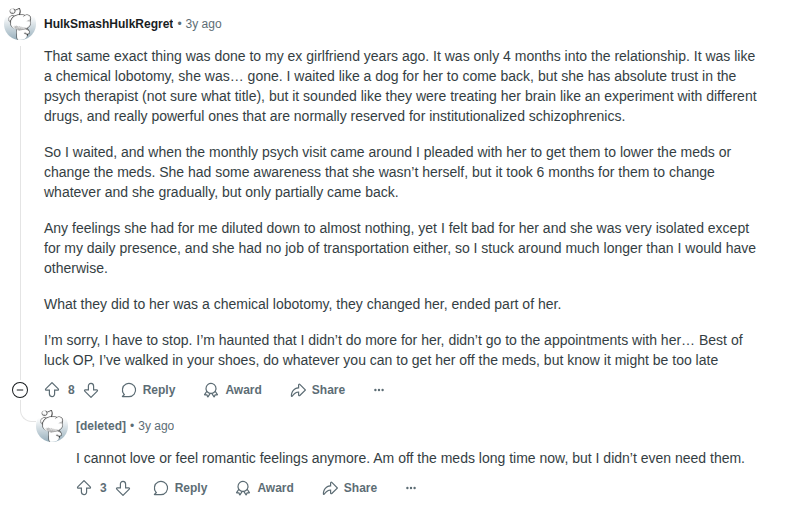
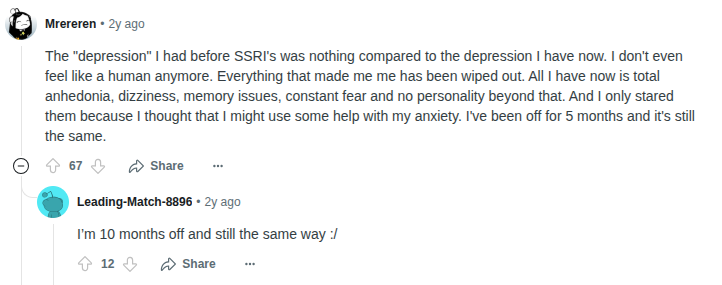
And here is a case in which the psychiatric medication apparently made the condition the person was treated for (depression) worse than before.
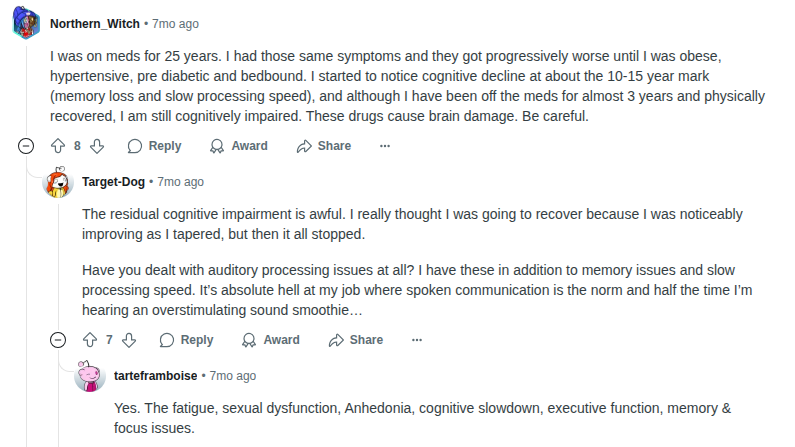
While working in corrections, I learned from a psych provider that the antipsychotic Haldol is neurotoxic. It appears that Risperdal is neurotoxic as well.
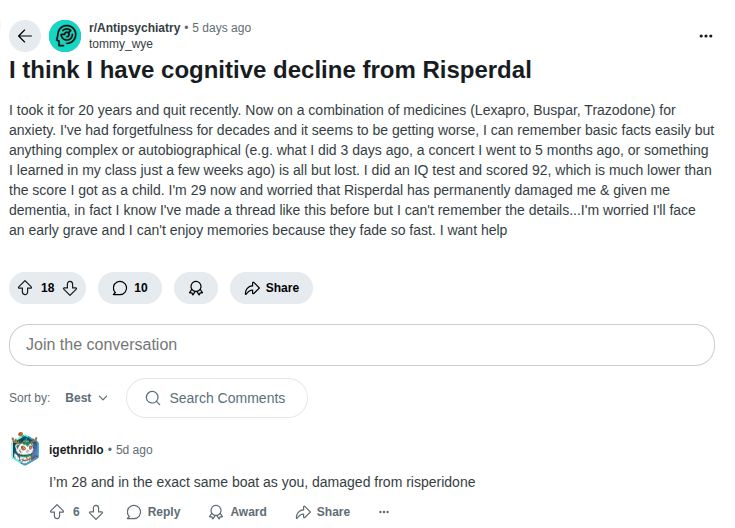
People tend to focus (rightly so) on the brain-damaging potential of street drugs, but the brain-damaging potential of psychiatric medication gets very little attention.
Conclusion
Am I advocating for people to just use street drugs instead? Absolutely not! For all its cons, at least with psychiatric medication, you are going to get a pharmaceutically pure product that has not been adulterated with gasoline, fentanyl, or whatnot. That said, I am not advocating for psych meds either.
A person who has a migraine problem caused by a tumor may take prescription painkillers year after year for migraine relief. Or, he could just could have the tumor removed, and then he will no longer be dependent on a chemical to relieve the symptom of the actual problem. Well, why don’t we approach mental illness similarly? I would like to see the imperative changing to finding the actual cause of the mental health symptoms and fixing that instead of relying on chemicals to feel more comfortable ad infinitum.
Other articles you may find of interest:
Exercise vs Antidepressants: A Comparison
“The Psych Meds Are Not Working” – This is Why (If You Did Drugs)
I agree with a major caveat: psych drugs, especially antipsychotics, are NOT feel good chemicals, they are feel BAD chemicals. Antipsychotics do not make you feel any better about your problems, in fact they make you feel a thousand times worse about them and also cause you countless other problems to feel bad about. Street drugs at least are intended to make you feel better.