
Reaction to Tom Cruise’s 2005 Interview with Matt Lauer
I recently re-watched a video of Tom Cruise’s famous 2005 interview with Matt Lauer, in which Mr. Cruise criticized psychiatry and Mr. Lauer defended it. One of Cruise’s peers, Brooke Shields, had gone public about her battle with postpartum depression and using antidepressants to cope. Tom Cruise expressed his disapproval of her decision to use psych meds, insisting that the issue could be addressed with exercise and vitamins (basically, self-care). In the aftermath of this interview, it appears that Cruise experienced backlash for his viewpoint — and also the intense way he expressed it.
After watching the interview myself, my reaction is that Tom Cruise was ahead of his time.
For example, he said, “There is no such thing as a chemical imbalance.” This tells me that he had, indeed, done his research on psychiatry. Yes, the notion that a chemical imbalance is to blame for mental illness has never, ever been substantiated. Nevertheless, many mental health professionals continue to spread this misinformation.
Another thing to take out of this interview and its aftermath is the sort of knee-jerk response a number of people have to anyone criticizing the experts. It tends to go like this: Well, you’re not a doctor, so what qualifies you to give an opinion? I think we all react this way in certain situations at times, though I believe it is unwarranted in regards to criticizing the mental health industry.
Here are some instances of this happening in the comments section:

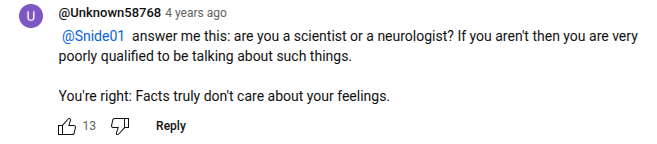
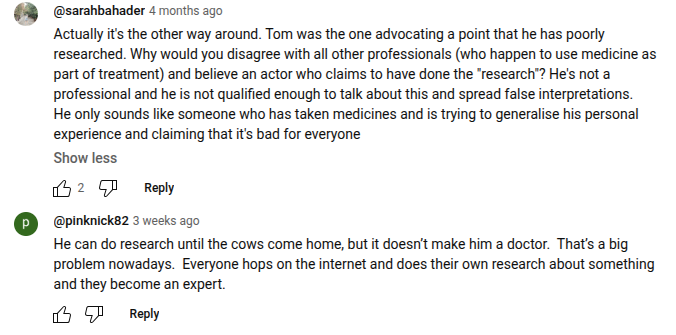
Clearly, this sort of reaction makes it understandably difficult for lay people to call out the mental health industry, because anything they have to say can be dismissed as “you can’t know what you’re talking about because you don’t have such-and-such degree.” Now, the people that react thus do not realize that the same criticism can be leveled at many of them. That is to say, most of them would not have worked in mental health themselves (as I did) and therefore do not realize that psychiatry and psychology are not rocket science. People who performed poorly in med school are apparently known to go into psychiatry (per a former psychiatric NP colleague), and psychology is one of the easier degrees to obtain. In fact, I know of two women who fraudulently posed as psychologists and actually pulled it off until one revealed the truth upon retiring and the other was exposed by detective work. I may write an article on this at some point. The point is: you don’t need a degree in advanced physics or molecular biology in order to dissect the mental health industry. You only need to be able to read. But, again, most people do not know this, and their impression of the mental health field is that it is deeper and more mysterious than it actually is.
Fortunately, there are plenty of psychiatrists and psychologists who call out their own professions, and their quotes can be presented as evidence from the experts themselves. Unfortunately for Tom Cruise, he did not bring up any of these people, possibly because he didn’t realize people would trust the experts so unquestionably or possibly because he was put on the spot when the topic of psychiatry was brought up. I don’t know. However, I will go ahead and provide a few quotes from some of these professionals:
With the latest technology, it is possible to determine if a chemical imbalance exists; none has been found. On the other hand, it is also an accepted fact that when psychotropic drugs are used, major changes in the brain occur. For example, with the use of both the older and newer antipsychotic medications, upwards of 87% of the dopamine receptors are blocked. Quoting Peter Breggin in reference to the antidepressant Prozac, “the receptors actually die off or disappear;” and with rats, “Up to 60% of some subtypes of serotonin receptors can disappear.”
–Ty C. Colbert, Psychologist (2017). The Four False Pillars of Biopsychiatry.
You come to my office, and I say to you, well, you – you describe what’s going on your life, and and your symptoms and I say, well, it’s clear to me that you’ve got a chemical imbalance, and we’re going to write you a prescription for this. The truth of the matter is there’s no such thing as a chemical imbalance.
–Louis Wynne, Psychologist in CCHRInt. (n.d.) The DSM Psychiatry’s Deadliest Scam [Video]. Youtube.
All of a sudden, the market got flooded by psychiatric drugs, which aren’t that much different than the illegal drugs. And interestingly, the street drug dealer and the psychiatrist aren’t all that much different, except for the fact that the street drug dealer won’t tell you that you have a chemical imbalance. The street drug dealer’s not going to tell you that you need to take his drugs, his cocaine. He’s not going to tell you you have a cocaine deficiency. The psychiatrist is going to lie to you most of the time and tell you that you need the drug, that it’s not going to be harmful to you, it’s not going to be addictive, and that it’s going to help correct some sort of chemical imbalance or genetic defect. In that case, for that type of psychiatrist, the street drug dealer is more ethical… Let’s not lie to people about it; let’s not pretend that this is medicine. Let’s not pretend that it’s going to correct something or somehow it’s a treatment. This isn’t a treatment; this is a drug. Just like any other drug, it’s going to mess you up, it’s going to screw you up.
–Toby Watson, Psychologist in CCHRInt (2017, Mar. 20). Psychologist Toby Watson – Psychiatry is Misleading the Public About Mental Disorders [Video]. Youtube.
There’s actually in fact dozens of studies showing that there isn’t any measurable imbalance. So psychiatrists will explain to patients all the time, “This is just like diabetes. In diabetes you have low insulin; we have to readjust insulin level. In depression, you have low serotonin; we have to readjust the serotonin level. But actually, we have already proven that there is nothing wrong with serotonin levels. It’s completely a myth, disproven by our own evidence.
— Colin Ross, Psychiatrist in CCHRInt. (n.d.) The DSM Psychiatry’s Deadliest Scam [Video]. Youtube.
You can find yet more quotes from mental health professionals exposing psychiatry here.
So, in conclusion, Tom Cruise definitely did his research on psychiatry, as he had insisted. Whether or not he researched the religion he follows, created by science fiction author L. Ron Hubbard, is unclear at this point. It is clear to me, however, that he hasn’t done his research on Christianity, judging by a comment he made.
Relevant articles: