
Long Term Effects of Anesthesia on the Brain
You think general anesthesia puts you to sleep. It actually puts you into more of a temporary coma. In fact, the very same drugs that are used to render patients unconscious during routine surgeries are also used to induce medical comas. You think all is good and the worst is over if and when you wake up from anesthesia. For many, that is certainly true, but for some unlucky persons, that is not the case, as among the side effects of general anesthesia is possible long term brain impairment.
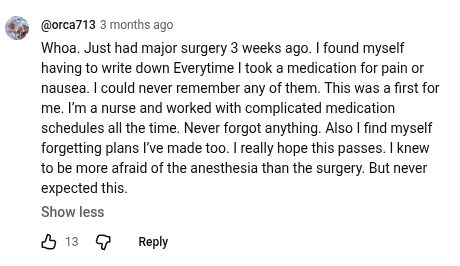
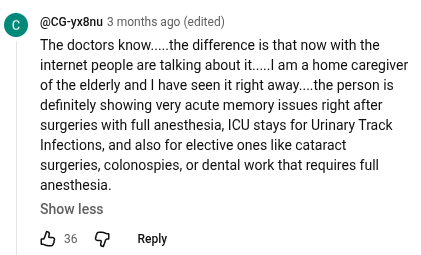
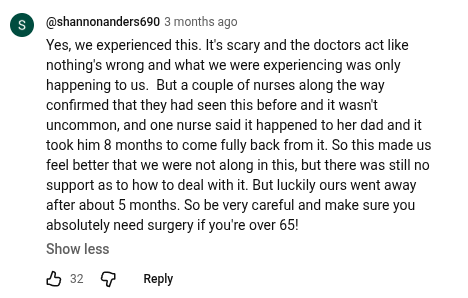
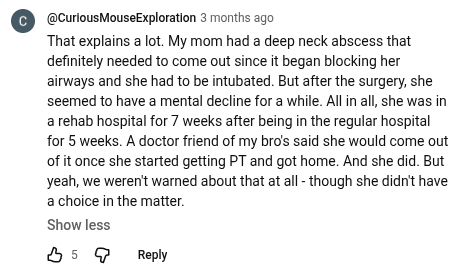
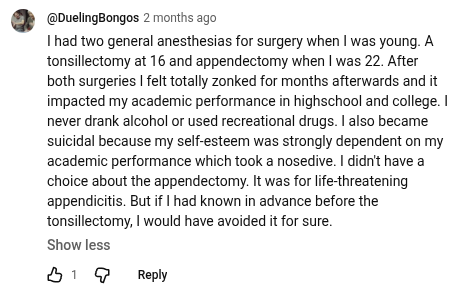
Many personal accounts are easily found online of people who have undergone surgery (or knew somebody else who did) and then experienced (or witnessed) alterations in mental abilities or even personality. Below are a bunch from the comments section of a video called “Why your parent seems DIFFERENT after surgery (doctors won’t tell you):”





Here are some more from another video discussing negative effects of surgery/anesthesia:

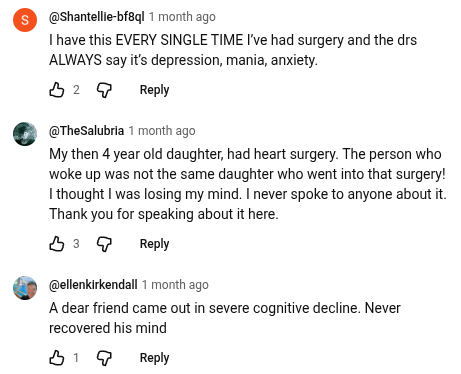
As you can observe, people are reporting side effects ranging from memory loss, depression, and paranoia to outright hallucinations, loss of intellectual functioning, and dementia. There were actually so many scary personal accounts that I had a hard time narrowing down a reasonable number to share here.
Notice the reports of people who found themselves essentially gaslighted by medical staff. Insult is added to injury when concerns get dismissed, dodged, or attributed to other factors, such as aging, stress, or even imagination.
Awareness of the harmful effects of anesthesia on the brain is not a new thing. These undesirable side effects would have been around for as long as modern anesthesia, which was introduced in the mid-1840s. Close to fifty years later, a paper reporting on insanity resulting from anesthesia appeared in a British medical journal. Nevertheless, the idea that anesthesia can cause lasting harm to the brain does not appear to be common knowledge in the general population. Based on what I have gleaned from reviewing personal experiences, I got the impression that physicians generally are not adequately informing their patients of the risk of neurological damage.
Why is this the case? Well, I found some answers on the internet, and frankly, they tended to sound more like excuses than explanations. For example, some argue that it is not easy to diagnose this syndrome due to a lack of standardized diagnostic criteria and patient feedback. Considering the extreme changes some commentators above observed and the complaints to medical providers that were disregarded, this sounds like a cop out to me. Also, some question if harm from anesthesia is really a thing and if patients are merely experiencing a reaction from other factors such as stress and post-surgical inflammation. While it is true that other elements of the surgery procedure can cause issues, it is also true that research confirms the neurotoxic potential of anesthesia.
All this said, as one commentator pointed out, the internet has allowed for people to connect and share their experiences all over the world, and this has no doubt placed pressure on medical professionals to acknowledge this post-surgery syndrome and start speaking out on it as well. A medical term actually exists for the long term effects of anesthesia on the brain – post-operative cognitive dysfunction or post-operative cognitive decline (POCD).
When discussing POCD at a senior center, Carolyn Holland, a nurse anesthetist, presented an overview of the common symptoms, which are as follows: “feeling fuzzy, memory impairment, impaired performance on intellectual tasks, loss of concentration, short attention span, personality changes, social interaction changes, disorientation, loss of perception, depression.” POCD appears to mostly affect those with a more vulnerable central nervous system, that is to say, the elderly or the very young.
Among the anecdotes I reviewed, I remember one person commented that patients are not given a clear picture beforehand of the risk of cognitive damage. This data does exist. In her presentation, Nurse Holland noted, “If you’re age 18-39, you’ve got about a 36.6% risk, 40-59 a 30.4[%] risk, over 60 a 41.4[%] risk.” So, the chances of getting POCD after surgery is more than 1 in 3 across the board. That is … unnervingly high.
Holland continued, “Twelve point seven percent of patients over 60 will have some degree of post-op cognitive dysfunction 3 months after surgery. And these statistics are for major surgery, but not cardiac surgery.” So, on the positive side of things, 87.3% of POCD cases resolve within 3 months.
Now that there is more knowledge on the possible long term effects of anesthesia, how does one protect the brain?
Well, the best way is obviously not to get surgery. That isn’t always possible in life-threatening events. The second best option is to try to get an alternative to general anesthesia, like a nerve block, spinal, epidural, local anesthesia, or monitored (“twilight”) sedation. These come with risks as well, though apparently lesser than that of general anesthesia. Note the comment of “yblgirl,” who experienced temporary POCD after undergoing general anesthesia for a series of foot surgeries, yet was okay after insisting that a local anesthetic, lidocaine, be used for three more surgeries on her foot. I can only conclude that it pays to be assertive with doctors and not let them intimidate you into something with which you are not entirely comfortable.
Modern anesthesia may be scary, but what came before was truly horrific. Prior to current anesthetics, surgery often involved being physically restrained while the surgeon sawed away as fast as possible. Rudimentary anesthetics included copious amounts of alcohol, opium (from which morphine is extracted), and herbal concoctions.
Anethesia has been called a necessary evil. On the one hand, it has its risks; on the other, who would undergo heart surgery without it? Or receive an organ transplant? In certain cases, such as for emergency medical procedures, anesthesia is an unavoidable reality. For elective surgeries, however, such as certain cosmetic procedures like facelifts or tummy tucks, I figure that a number of people might change their minds about having the surgery if they were adequately informed of the risks for their brain health.
References:
1. Biello, D. (Jan. 10, 2011). What Is a Medically Induced Coma and Why Is It Used? Scientific American. https://www.scientificamerican.com/article/what-is-a-medically-induced-coma/
2. Abhyankar, R.S. & Jessop, K.M. (Jan-Feb 2022). From Craft to Profession: The Development of Modern Anesthesiology. Missouri Medicine. https://pmc.ncbi.nlm.nih.gov/articles/PMC9312459/
3. Greenwood, M. (updated Aug. 7, 2023). What is Post-Operative Cognitive Decline? News Medical Life Sciences. https://www.news-medical.net/health/What-is-Post-Operative-Cognitive-Decline.aspx
4. Summit County Colorado. (Feb. 21, 2017). Post-Operative Cognitive Dysfunction [Video]. Youtube. https://www.youtube.com/watch?v=MuWpLt-6h6g
5. A Brief History of Anesthesiology. (n.d.) Sarasota Memorial. https://smhfpg.com/a-brief-history-of-anesthesiology/
6. Roos, D. (Jul. 14, 2025). How Did Doctors Operate Before Anesthesia? History. https://www.history.com/articles/surgery-anesthesia
7. Massey, R. ((Jun. 14, 2024). The Risks of General Anesthesia and 3 Alternatives to Sedation. Ralph A. Massey MD. https://www.ralphmasseymd.com/blog/the-risks-of-general-anesthesia-and-3-alternatives-to-sedation/
8. Wu, L., Zhao, H., Weng, H., & Ma, D. (Mar. 11, 2019). Lasting effects of general anesthetics on the brain in the young and elderly: “mixed picture” of neurotoxicity, neuroprotection and cognitive impairment. Journal of Anesthesia. https://pmc.ncbi.nlm.nih.gov/articles/PMC6443620/#Sec2
9. Santa Cruz, J. (n.d.) Surgery and Cognitive Dysfunction. Today’s Geriatric Medicine. https://www.todaysgeriatricmedicine.com/news/ex_032816.shtml
10. Monk, T.G. & Price, C.C. (Aug. 2011). Postoperative cognitive disorders. Current Opinion in Critical Care, 17 (4). https://pmc.ncbi.nlm.nih.gov/articles/PMC3882015/
Other articles:
Can You Trust Research on Psychology Topics?